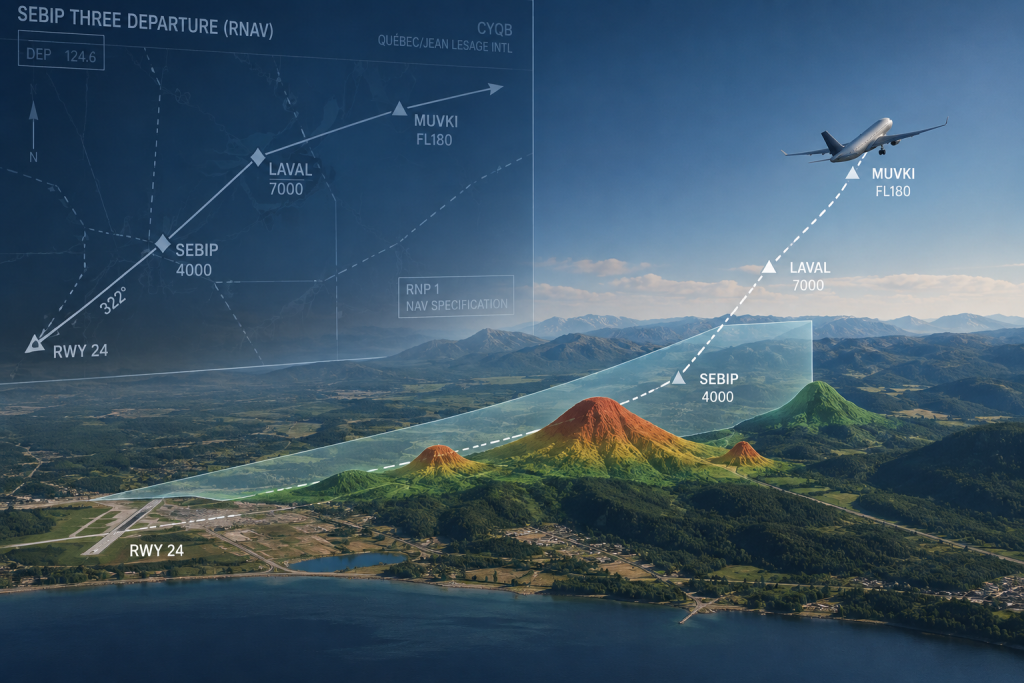
For IFR pilots, departure procedures are a familiar part of flying. We review the chart, check the climb requirements, load the SID and brief the departure.
But have you ever wondered how those procedures are actually designed — or why a particular climb gradient, routing or restriction exists?
In our latest 49th Degree Aviation webinar, Alexandre Schmid, an experienced procedure designer, takes us behind the scenes of IFR departure procedure design.
What Goes Into a Departure Procedure?
The webinar begins with some of the fundamentals behind obstacle departure procedures, including the assumptions designers make about aircraft height, climb performance and turns after departure.
Alex also explores close-in obstacles and demonstrates how something as simple as a tree near the departure end of a runway can influence the obstacle clearance calculations behind a procedure.
It’s a useful reminder that the notes, restrictions and climb gradients we see on a chart are there for a reason.
Building a SID
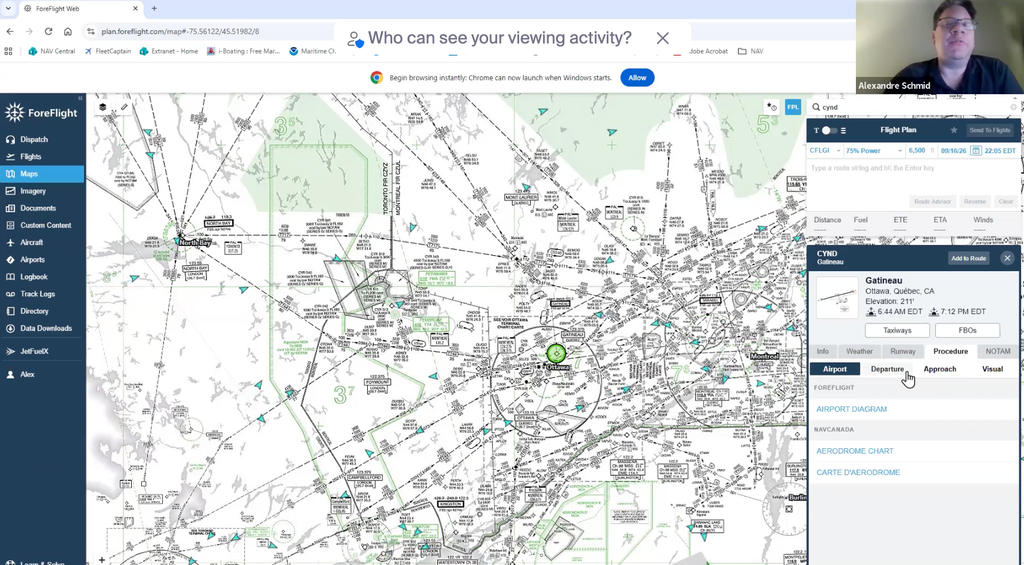
From there, Alex takes things a step further by opening the procedure design software and building a real SID using the SEBIP 3 Departure from Québec City as an example.
Along the way, he introduces some of the information designers work with, including:
- Aeronautical and runway data
- Obstacles and terrain
- LiDAR and vegetation data
- Route protection areas
- FMS leg types and waypoint coding
- Climb gradients and altitude restrictions
Seeing a familiar-looking SID constructed from the designer’s perspective gives pilots a very different appreciation for what sits behind the finished chart.
Looking Ahead
The webinar also offers a glimpse at where Canadian air traffic management may be heading.
Alex discusses Digital Aerodrome Air Traffic Services (DATS) and Trajectory-Based Operations (TBO) — including how better aircraft and ATC data sharing could eventually make the time component of a flight increasingly important alongside position and altitude.
These are technologies and concepts pilots may hear.
See how an IFR departure goes from design criteria to the procedure pilots fly.
Passcode: rB5nVb*M
This is not an authorized NAV CANADA presentation. It is an independent discussion with an ATPL-licensed pilot who has experience with NAV CANADA’s IFR procedure design processes.